Fabric wheel covers
Printed From: BHPC Forum
Category: Public: Open to anyone
Forum Name: Building
Forum Description: Anything to do with building HPVs
URL: https://forum.bhpc.org.uk/forum_posts.asp?TID=7739
Printed Date: 26 March 2026 at 10:38pm
Software Version: Web Wiz Forums 12.07 - https://www.webwizforums.com
Topic: Fabric wheel covers
Posted By: Yowie
Subject: Fabric wheel covers
Date Posted: 19 December 2024 at 6:49pm
|
Hi people, I need a bit of advice on fabric covered wheels. I did this myself already once on Great White - went ok, however, this time is not so successful. Same as last time, I hot melt glued ripstop polyester to the rim, stretched it bit by bit using a hot iron to release the bond around the rim. So the result was fairly acceptable, yet a bit floppy. I remember I used some sort of dope which I might have painted on, can't remember, probably supplied to me by Dave Tigwell. I am actually using the identical material, I know there are many sorts, obtained from a kite store. It is I believe ripstop polyester. So I read somewhere I can spray on a nitrocellulose lacquer. So that's what I tried. And now the covers appear even floppier than before. If I blow a hairdryer on them they go momentarily taught. 30 mins later sagging. I think I need more heat. Some say to tension the fabric then lacquer, so maybe I've already b****red up. Any advice please? |
Replies:
Posted By: Martin Kiszel
Date Posted: 20 December 2024 at 11:05am
|
Hi Yowie (Howard?) I've only had experience with Ripstop nylon, uncalendered, untreated. Also silk, tissue, polyester tissue (polyspan), most plastic covering, solarfilm, solartex, Orc cover, mylar and other heat shrinks. But not Ripstop polyester as I think that doesn't stretch like nylon covering does. The glue for fabric covering, hasn't been solved for longevity yet, I used cellulose nitrated dope last time. It lasted 2 race meetings (2month) then started coming away. I would try, contact adhesive, superglue or even epoxy in the future. I come from a 58-year-old aeromodelling background where pins would be used to position and hold the nylon on. The nylon is sprayed with water which slackens the nylon, and I would pull the covering tighter (snug) by pulling out the pins and reinserting the pins, one by one, going around the outside. With metal rims, you can't do this, so I covered both sides at the same time and used safety pins, going through both sheets top & bottom, to secure the nylon on first. So, apply at least 2 coats of dope on the rims, let the dope dry. Make and attach the center hub support plywood annulus (disc with a hole) to the center of the nylon. Fit over the wheels. Do the water spray and pull the covering, snug or tight, then re-pin to hold its position. Once the water has dried, I would dab dope through the rim edge (12mm band) using several coats, until enough has gone on to hold the nylon on, about 4 or 5 coats of 50/50 dope/thinners. I only use a brush, spraying is wasteful and a hazard because of airborne particles. Leave that lot to hard off for a few days or more. Start doping the nylon with 4/5 coats top & bottom, don't go over the glued areas or the 'glued' area will let go. Leave to dry between coats. After 4 coats I test to see if I can blow or suck through the covering. If you can't next step is to cut the outer nylon that isn't needed, this could be done earlier if you are confident the nylon is holding the nylon. This is the method I have used up to yet. A stronger glue is needed. Also, some rims are treated, anodised, or powder coated and can reject glues. What I have found to cure this requires the rims to be wet and dry 'sanding' back to the base metal. Hope you don't mind that nice paint job being scuffed up, needs must! The results I got was a drum tight covering, pity it didn't last long enough, I shall try epoxy next time. The nylon was superbly resistant to knocks and weather, but doped nylon carries on shrinking for some months and this is what caused the detachment from the rims. I am sure this is solvable but I have yet to try it, maybe in 2025 I will. Hope you find this useful. Picture needed of how I use the pins, hmm later. |
Posted By: Yowie
Date Posted: 20 December 2024 at 12:46pm
|
Hi Martin, The material i am using is basic ripstop polyester for kites and tents with no treatments. I cant tell you the weigh, weave or manufacturers intent for it. Untreated. It has limited give at 45 degrees to the weave, gives somewhat when damp. I have a good bond to the rim, my difficulty will be removing it to redo! I can't restretch easily because there's nothing to get a grip on. What i will try next: Remove and refit, may be too fiddly. Or, Redo from scratch this time using my hot melt glue technique the same as you described with pins, dampening the fabric this time in the larger areas to create that give. Then doping when is taught. Thank you, Howard |
Posted By: Martin Kiszel
Date Posted: 20 December 2024 at 1:26pm
|
Sounds like redo from scratch is easier especially if you've doped the covering all over, you can't really stretch that and stick it back down. Where are you based? |
Posted By: Martin Kiszel
Date Posted: 20 December 2024 at 2:24pm
|
Just been told polyester ripstop is heat shrunk after covering it shrinks by 10%. Then do the doping or as the friend mentioned he used Wilko varnish (should be alternatives). This means you'd only get one hit with the shrinking. I highly recommend ripstop nylon, it should cost <£5 for material then go to modelling supplies for the high taunt nitrated dope. Small quantities cost more per 100ml than buying a 4.5~5 litre can. I used Skycraft in the past but lately I buy from LAS Aerospace ltd, but if you want small tins models shops are good. Leeds Model Shop have Kavan shrinking dope standard 250ml for £7.59 at the moment. BTW 5litres is +£80. |
Posted By: RoyMacdonald
Date Posted: 20 December 2024 at 2:41pm
|
Howie, Have you thought about using thin ABS or similar and taping it across and trapping the spokes in between. I did that on my Kingcycle front wheel and that was very successful. The rear is secured using clips onto the spokes. A stiffer surface is more aerodynamic on wheels. Look at the Beano. All the best. Roy 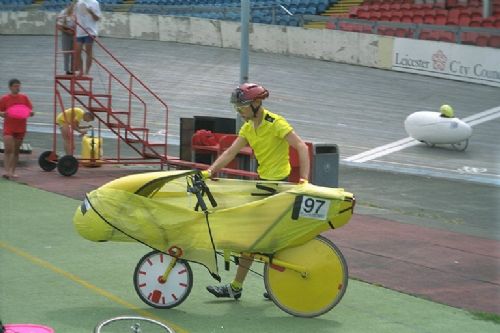 |
Posted By: BarneyH
Date Posted: 20 December 2024 at 5:22pm
|
Howard I always credit you with the method I use when I get questioned about mine, maybe reading this it wasn't your method. I cut circle from the same ripstop kite / spinnaker fabric you're using ( cheap 10m deal off e-bay ) hemmed it on the sewing machine to perfect circle, inserted 2mm kite fibreglass rod to create circle with rigid edge . Then made alloy clips from sections of wheel rim, choose a spoke hole cut a section about 25mm including hole and then cut a slot to allow the clip to slide over spoke and then hole down over nipple, the inverted rim then acts as a clip to clip in the fibreglass pole reinforced edge. I was 100 % certain you'd talked me through this so have on many occasions given you the credit. Good luck Barney
|
Posted By: RoyMacdonald
Date Posted: 20 December 2024 at 6:31pm
|
Barney. I'm reasonably sure that was the type of disc covers that were on the Great White when I bought it from Howie. All the best. Roy |
Posted By: Yowie
Date Posted: 22 December 2024 at 12:00pm
|
Yes people, the kite rod method is mine, probably inspired by someone before me. It works well when you still need the rim for braking. Rear wheel of the Great White though had the stretched hot melt glue technique, I had disposed of the rear brake. My latest results with this are now better, near perfect. As i describe above, dampening the fabric while gluing. When the polyester dries, it retensions itself. follow this up with another heat treatment on Medium iron (clothes).. . You get up to 10% shrinkage in theory. I am based in Germany, So some of these products and a little harder to identity in the shops. Nitrile celulose varnish / dope for example i bought from a guitar shop.. |
Posted By: RoyMacdonald
Date Posted: 22 December 2024 at 1:07pm
|
Thanks Howie. I remember now that's why I had to take the rear cover off as I felt the Great White would need the rear working for stability at speed and I was also gearing it higher with lighter wheels (Frattelli rims) and wanted an easier more reliable shift as I found it sometimes did not change and got stuck in gear which could prove disastrous on my training run which included some very steep hills and I expected to be hitting 60 mph on the downhill section with a sharp right hand turn at the bottom. I needed a reliable low gear for the climb up to the top of that hill as well. That hill is where I broke the rear swinging arm on my velomobile when it did not shift properly and I tried to force it. After it was repaired I never tried to force it again and got out of the velo and put the chain back on if it came off. I did used to hit 60 mph on the downhill. On the climb though I could only do about 4 mph though and I would have needed to go faster than that for a bike. I think I needed to do about 7 mph to feel safe on my Kingcycle with the fairings on.< id="BFI_" style="width: 1px; height: 1px; display: none;"> All the best. Roy
|